Phone Directory listings for Greenville County bring together residential landlines, mobile numbers, and business connections in a single, searchable platform, letting users find a name, address, or number within seconds. By typing a street name, a business title, or a partial digit string, the Greenville County phone directory online instantly returns relevant results, filtering out outdated or unlisted entries. This fast lookup respects privacy rules while delivering the most current telephone listings for households, offices, and government agencies.
When you need a Greenville County phone number lookup by address or a reverse phone search for a mobile line, the directory’s telephone listings deliver precise matches without extra clicks. Users can explore Greenville County business phone directory, government phone directory, and even toll‑free numbers, all verified for active status. The system flags disconnected lines and guides you to update or verify contact details, ensuring reliable communication every time.
How to Search Phone Directory
A Greenville County phone directory search can match a person, household, business, public office, or organization by name, street address, business title, or telephone number. Results can mix residential landlines, mobile numbers, business connections, and toll-free numbers, so each result needs a quick check for line type, address, and source date. You can also consult phone lookup to locate official filings. The steps below explain how to build a search, review matching records, and confirm a contact before use. The supplied source names no government-operated search portal, so each directory applies its own publication and update rules.
Official Search Portal: N/A (No Official Government Source)
Steps to Search
- Open the directory page and set the search area to Greenville County. If the page does not include a location filter, include “Greenville County” or the relevant city in the search term.
- Choose the field that matches your goal. Enter a full telephone number for a number search, a full name for a name search, or a street address for an address search. For a business or public office, enter the organization name rather than a person’s name.
- Enter digits only when searching by telephone number. Include the area code and any extension shown by the organization. A seven-digit local search can return unrelated records in another area code.
- Add location details when a name is common. A surname plus Greenville County or the listed city is usually more useful than a surname alone. For a business, add its category when the first search returns several matches.
- Separate the street number from the street name for an address search. Include an apartment, suite, floor, or unit when applicable, since one building can contain many telephone records.
- Review the name, address, telephone number, category, and update date shown beside each result. Check whether the number is labeled residential, mobile, business, toll-free, or government-related.
- Compare the result with a current source controlled by the person or organization. A business website, public agency page, billing statement, or another recent directory can confirm contact details without relying on one record.
- Call only during normal business hours when the listing belongs to an organization. Treat a successful connection as one signal of accuracy; it does not prove that the caller has reached the intended person or department.
- Try a broader search when no result appears. Remove a unit number, try the organization name without punctuation, check a former address, or search the full number without an extension. A missing result does not mean the person or business lacks a telephone number.
- Record the directory name and the date checked. This creates a simple trail for spotting later changes, especially for a business office, local office, or frequently used residential line.
Search Methods by Name, Address, and Number
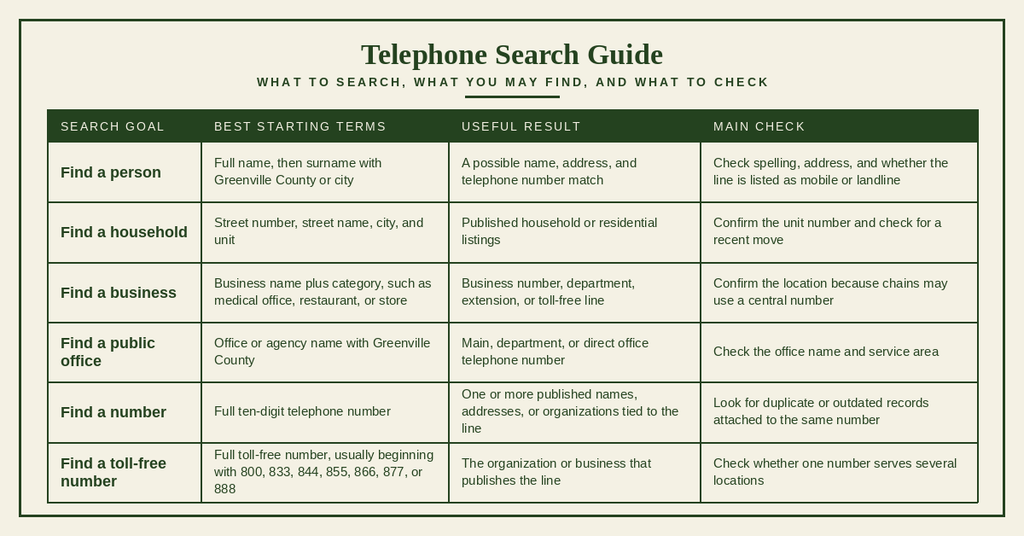
Search terms work best when they balance specificity with enough detail to separate similar records. The table shows the most useful entry method for common tasks and the field that deserves the closest review.
Name Searches
A name search works best when the query mirrors the form used by the publisher. Start with the full published name, then narrow the result by county, city, business category, or address. This prevents a common surname from filling the result page with people from other places.
- Use the spelling shown in the result when refining a second search.
- Add a middle name or initial only when the record supplies one.
- Search businesses by their operating name rather than a personal proprietor’s name.
- Add a department or service type when several branches share one business name.
- Keep the city and street details separate so one extra word does not remove every match.
Address Searches
An address search can narrow a large directory to a building, household, or business site. The street address must appear in the listing for this method to produce a match, so a missing suite, old street name, or misspelled road can remove the right record.
- Begin with the house number and full street name.
- Add the apartment, suite, floor, or unit shown by the source.
- Add the city, state, or ZIP code when the street name repeats in the region.
- Include the business or office name if several organizations share one address.
- Search both the current and former address when a listing appears outdated.
Number Searches
A full-number search gives the cleanest comparison because it checks one exact line. If the page accepts a partial number, review every returned suffix rather than selecting the first name. One number can carry several listing labels, including a business category, an organization name, or a former household record.
- Include the country code for a number outside the United States.
- Remove an extension when the first search fails.
- Check punctuation only if the directory requires it.
- Compare the area code, full number, and published category before contact.
Choose the Directory Type That Fits the Task
Different search products organize similar facts for different needs. A Greenville County phone directory is designed for published telephone listings, while people, address, business, and public-record searches can return a wider mix of material. Choosing the right product reduces irrelevant results and helps keep private data out of view.
A public phone directory and a public-records search are separate systems. The first presents telephone listings assembled by a publisher. The second searches records produced by government agencies or other record holders, subject to each record’s rules. A number absent from one system may still appear in the other.
Listing Categories & Phone Line Types
Telephone directories often place records into broad categories that reflect how a line is used. These categories help explain why one number may appear under a household, a company, or a public agency. They do not prove the line’s present owner, physical location, or service status.
Residential landline listings may connect a household or resident to a street address. Verify the address and move date before relying on the information. Mobile number listings may identify a person or business but do not prove residence. Business numbers can belong to companies, branches, or professional offices, so check whether the line is local or centralized.
Toll-free numbers often serve multiple locations. Search by the full number or brand name. For government offices, verify the department through its current official website. For organizations, confirm the full name and check whether the listing is outdated or duplicated.
Residential Landlines & Mobile Numbers
A residential landline is a traditional geographic telephone service associated with a service address. In a directory, it may appear beside a household name, a resident, or a former subscriber. The address is a useful matching field, yet it can become stale after a move, a line transfer, or a change in service.
A mobile number behaves differently because it can travel with the user and may not depend on a fixed street address. A Greenville County result for a mobile line can reflect the owner’s listed area, connection area, or another source association. The record alone does not prove that the person currently lives at the displayed address. For that reason, check the address against a recent source before sending a time-sensitive package or visiting the property.
Search by surname and city first when the number is unknown. If several people share the surname, add the street name, organization, or other unique detail. When the number is known, a reverse phone lookup can show every published name attached to that line, which helps identify duplicates and older records.
Business & Toll-Free Phone Connections
A business telephone record may point to a main office, a department, a direct line, a branch, or an after-hours service. Some listings include an extension, so callers should follow the published department instructions rather than assume that every employee uses the same line. A business name can also produce records for separate branches with identical or similar categories.
Toll-free numbers remove the geographic distance between the caller and the organization. The number may route to a call center, a regional office, or a service that operates in many states. Its presence in a Greenville County business phone directory does not mean that the answering location sits inside the county. Match the business name, official website, and service address before using a toll-free line for a location-specific request.
- A main number connects callers to a company or local office. Ask to be directed to the correct department or branch.
- A direct number reaches a specific person, team, or function. Confirm that the contact details are current.
- An extension provides an additional route through the main telephone number. Enter it when requested.
- A toll-free number serves customers across multiple locations. Provide the relevant county or address to help route your call.
- An after-hours number supports contact outside regular office hours. Check the published hours and emergency instructions before calling.
Municipal & Public Office Lines
Public offices can publish a switchboard number, a department number, or a direct administrative line. County departments, municipal offices, courts, schools, libraries, and other agencies may all appear in a telephone directory, even when no county-wide list identifies every office. A shared switchboard can also create many records that lead to the same central telephone system.
Search by the office or agency name, then add the relevant department or service. For example, a search for a county records office should use that office name rather than a general phrase such as “government phones.” Before relying on a public-office number, compare it with the agency’s current official website or a recent government publication. A directory record can remain online after an office moves, merges, or changes its telephone system.
For routine questions, call during the hours published by the agency. A shared line may route the call to several offices, so the caller should state the relevant department at the start. This reduces the chance of sharing personal details with the wrong desk and makes the requested transfer faster.
Listed Addresses & Organization Categories
An address search depends on the exact form published in the directory. Street names, building numbers, rural routes, post-office box numbers, and unit labels can each appear in different formats. Two records may point to the same property but look unrelated because one uses a mailing address and the other uses a physical site address.
Organization categories help narrow broad searches. A business name may appear under retail, medical, legal, financial, food service, real estate, nonprofit, government, education, or another classification. You can also explore residents directory through available county records. Use a category only when the listing already supports it; adding an incorrect label can remove a correct match from the results.
For single-family homes, include the house number, street, city, and county to avoid outdated listings. For apartments or suites, add the unit or floor number to distinguish individual locations within the same building. For businesses, search by company name and street address, as one central number may serve several branches. Post-office boxes may not match telephone records that require a physical address.
For government offices, include the agency, county, and department. For nonprofits or associations, use the full organization name and service area to avoid confusion with shortened names.
Public Availability & Privacy Rules
A public phone directory is a publisher’s compilation of selected telephone listings. A number can be listed because a source chose to publish it, yet that does not mean the subscriber agrees to marketing, repeated calls, or disclosure of unrelated personal facts. Directory users should keep the purpose of each search narrow and use published contact data only for a legitimate reason.
Availability also differs among publishers. One source may carry a business listing while another suppresses it. A person may choose a private or restricted telephone service, and a directory should not reveal the number when the source marks it as unavailable. Public-record availability can also depend on the record type, request rules, and the source that holds the material.
Public Directory Logs & Unlisted Numbers
A listed number has been published by the directory being searched. An unlisted number may be absent because the subscriber asked for privacy, the publisher’s source did not supply it, the listing was removed, or the record never existed in that collection. These situations look similar in a search box but require different responses.
Directory logs can contain records from several source types. A telephone carrier may supply service data, a subscriber may supply preferred contact details, and a publisher may add a public-record match. These inputs can disagree. A phone record tied to an address does not always prove that the telephone service uses that address, and a mobile record does not always reflect the owner’s present home.
Use a directory for discovery, then confirm the contact through a source controlled by the person or organization. For a company, that source may be its official website, a current invoice, a sign at the entrance, or a phone menu reached through the main number. For a public office, the agency’s own published site is the better choice for current departmental details.
Directory Removal & Opt-Out Requests
A removal request affects the directory that received it. It does not automatically remove the number from a carrier’s records, another phone book, a business listing, or every public-record source. The exact request method and processing time depend on the publisher’s posted policy, which was not supplied for this page.
The Do Not Call Registry at donotcall.gov registers phone numbers for protection under federal telemarketing rules, but it does not remove numbers from every directory or block all calls. To correct or remove a directory listing, contact the publisher through its official privacy or contact page. To manage customer-specific telephone preferences, use your carrier’s official account or privacy page. These options affect only the relevant organization’s records or services.
- Identify the publisher that created the disputed listing. A page footer, privacy notice, or contact link can reveal the company responsible for the record.
- Open that publisher’s published privacy, correction, or removal process. Use the channel shown on its own site rather than sending personal details to an unrelated address.
- Locate the exact record. Copy the published name, telephone number, address, and the page URL so the publisher can identify the listing without guessing.
- State the requested action clearly. Ask for removal, suppression from future searches, correction of an old address, or removal of a duplicate record.
- Provide only the facts needed to locate the record. Avoid sending identity documents through an unsecured email message unless the publisher’s official process requests them through a protected channel.
- Save a written confirmation or reference number. Check the listing again after the publisher’s stated processing period.
- Repeat the request with other publishers if the same telephone number appears in separate directories. Each company controls its own published collection.
A business or public office should use its official administrative contact when a published agency listing is wrong. A private subscriber should use the directory publisher’s removal channel. This keeps the request with the party that can act on that record and reduces the chance of sending sensitive facts to an unrelated office.
Record Accuracy & Resolution
Phone directory accuracy depends on the publisher, its sources, the date of each record, and the actions of subscribers and organizations. A directory can mark a disconnected line, carry an old address, or show two records for one number. Resolution works best when each claim receives a separate check rather than accepting the first matching name.
Three levels of evidence help separate a published listing from a confirmed contact. A directory label reports what one source publishes. Agreement between current sources raises confidence. Direct contact with the person or organization provides the strongest check, provided the line reaches the intended party.
- Directory label: useful for finding a possible record and seeing the category attached to it.
- Current source agreement: useful when a company website, agency page, and recent directory show the same number and address.
- Direct response: useful when the organization confirms the department, service area, or person associated with the line.
No single signal should be stretched beyond what it proves. A successful call proves that a line answered. It does not prove ownership, location, availability, or identity. A missing record proves only that the searched source lacks that match.
Verifying Active & Disconnected Lines
An active line normally produces a tone, greeting, or recorded message when called. A disconnected line may produce an automated message, immediate termination, or a status shown by the directory source. These outcomes can overlap because carrier status updates may lag behind a recent change, and some businesses screen calls through another service.
- Check the status shown in the directory. Note whether it says active, disconnected, changed, or unverified.
- Compare the number with a recent source controlled by the organization. A current invoice, official site, appointment message, or business listing can show the number that customers should use.
- Call during normal published hours when the purpose is legitimate. A greeting naming the correct business or department supports the listing.
- Listen to the complete voicemail greeting. A personal name, office title, or department can confirm more than the mere fact that a call connected.
- Compare the response with a second current number if the organization has one. A main line and direct line may route to separate departments or locations.
- Record the result and date. Update your own contact list so the next search does not begin with an outdated assumption.
No answer does not prove that a line is disconnected. Call screening, a full inbox, weak reception, or an outside service area can interrupt contact. A source that marks a number disconnected may also be reporting an earlier status. For a critical transaction, rely on a current organization-controlled source instead of one stale directory label.
For a public office, a recorded greeting can confirm that the telephone system reaches the intended agency, yet it may not confirm a particular department. State the office name and ask to be transferred. For a business, a generic greeting may represent several branches, so provide the street address or service needed for correct routing.
Resolving Address Relocations & Updates
An address in a phone listing can become outdated without any change in the telephone number. People move, businesses relocate, offices merge, and organizations keep old switchboard records in circulation. A relocation can affect the name, street number, city, unit, and organization category in different ways, so each field may need its own check.
Outdated addresses may appear after a household or business moves. Search using the latest street address or business name. For changed units or renamed organizations, compare current details and official listings. If a search returns a nearby city or duplicate entries, verify the full address and keep the most current information.
Mail forwarding or an old public record does not prove that telephone service moved with the person. The carrier may retain a service address while the subscriber uses a mobile number elsewhere. For the same reason, a business may keep one number after changing locations, or move while keeping the original number. The directory cannot resolve that fact by itself.
Search the old and new address separately, then compare both with the same name and number. If one address produces a current match and the other produces a stale record, request correction from the publisher. Keep the change date with the corrected entry so a later search can reveal whether the update held.
Unlisted Phone Number Directory Resolution
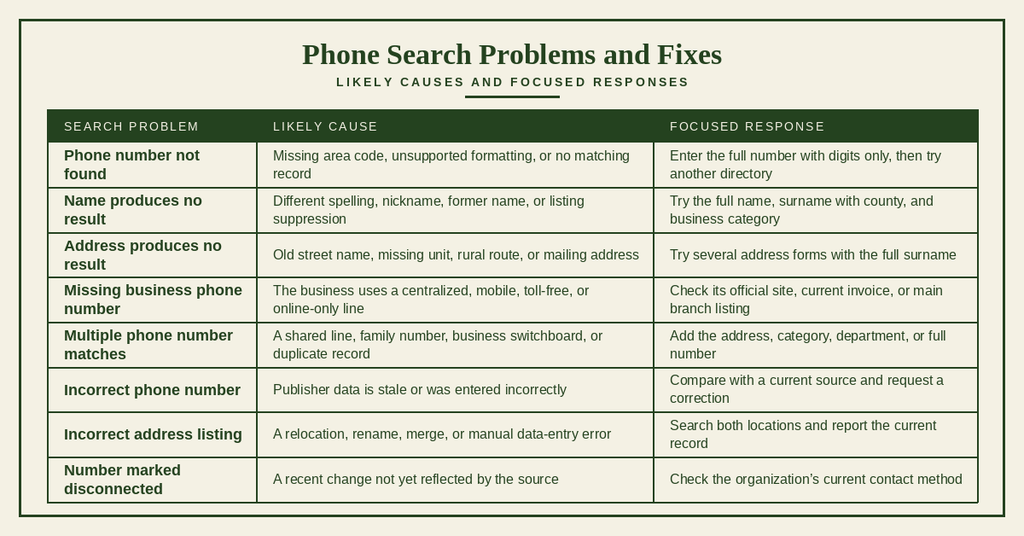
A phone number search problem can arise from formatting, incomplete records, privacy choices, duplicate entries, or outdated information. The correct response depends on the symptom shown on the page. Repeatedly changing a number through several unrelated directories may create more confusion than a focused check of the original source.
- Write down the exact failed search term and the result message. This shows whether the issue is a missing record, a formatting problem, or a conflicting match.
- Normalize the telephone number by removing spaces, punctuation, and an extension when the first attempt fails.
- Search the surname alone with Greenville County, then add a street, city, business category, or organization name.
- Check whether the same telephone number appears under another category. A line assigned to a business can carry a residential owner’s name or an old address.
- Use a current organization-controlled source for a business or public office. This source can confirm whether the directory entry is wrong or the intended line is private.
- Send a correction request to the publisher if its own listing contains an error. Include the old value, current value, and page reference so the record can be located.
If no current source can confirm the number, avoid repeated calls based on one uncertain record. A missing listing does not establish that a line is unlisted, and a directory match does not establish that someone currently uses it. The safest result is a confirmed number tied to the correct name, location, and service need.
Frequently Asked Questions
Below are quick answers to common questions about using the Greenville County phone directory and related lookup tools.
How to search Greenville County phone directory?
Start by visiting the online portal that hosts the Greenville County phone directory. Enter the name, address, or known phone number into the search box. Choose the appropriate filter residential, business, or government—to narrow results. Review each match for line type and date stamp, then click the record to see full details. Confirm the information by checking the listed address or organization before using it. This approach works for both landline and mobile numbers across the county.
Find a business number in Greenville County listing?
Yes, you can locate a business phone number using the Greenville County business phone directory. Type the business name or its industry category into the search field, then apply the “business” filter. Results will show the company’s name, phone number, and address. Verify the entry by matching the address with the known location of the business. If multiple matches appear, compare the listed phone types to ensure you select the correct line, such as a toll‑free or local number.
What info appears in a Greenville County phone lookup?
A standard Greenville County phone lookup returns the name associated with the number, the full street address, and the type of line—landline, mobile, or toll‑free. It may also include the date the listing was last updated and a classification indicating residential, business, or government usage. Some entries show additional notes like suite numbers or building names, helping you confirm the correct contact before reaching out.
Why might a phone number be missing from the directory?
A number can be absent if the owner opted out of public listings, if the line is newly assigned, or if the record has not yet been updated. Private or unlisted numbers are deliberately excluded to protect privacy. Additionally, numbers that have been disconnected or transferred to another provider may remain unrecorded until the next directory refresh.
How often is Greenville County phone directory updated?
The Greenville County phone directory is refreshed on a quarterly basis. Each update incorporates new residential and business listings, removes disconnected numbers, and revises changed addresses. Users should check the “last updated” date shown on the portal to confirm the currency of the data before relying on it for outreach.